

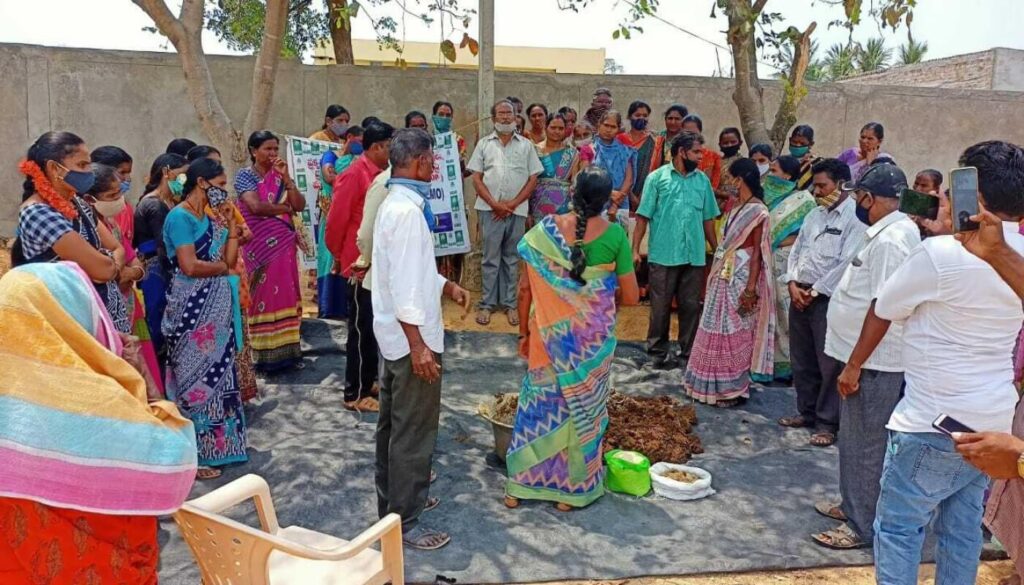
The Andhra Pradesh Community Managed Natural Farming (APCNF) program is witnessing rapid expansion across the East Godavari district, transforming the way agriculture is practiced in one of the state’s most fertile regions. The initiative, supported by the state government and implemented through community-based farmer groups, focuses on shifting cultivation from chemical-intensive methods to low-cost, eco-friendly natural farming practices.
At the core of APCNF is the principle of reducing dependency on synthetic fertilizers and pesticides while improving soil health and long-term productivity. Farmers are trained to adopt natural inputs such as Jeevamrutham, Ghana Jeevamrutham, Beejamrutham, and botanical extracts, which are prepared locally using cow dung, cow urine, pulse flour, and other organic materials. These inputs not only reduce cultivation costs but also enhance microbial activity in the soil, leading to improved crop resilience.
In East Godavari mandals such as Kadiyam, Amalapuram, Rajahmundry rural, and Peddapuram, thousands of farmers are actively participating in APCNF training sessions conducted by master trainers and local agricultural extension officers. Women self-help groups (SHGs) play a major role in preparing and distributing natural farming inputs, making the program both economically and socially inclusive.
One of the key strengths of the APCNF model is its farmer-to-farmer learning approach, where experienced practitioners guide new adopters in field-level demonstrations. This approach helps in building confidence among farmers who are transitioning away from conventional farming systems. As a result, many farmers report noticeable reductions in input costs, especially in fertilizers and pesticides, while maintaining stable yields in crops like paddy, maize, vegetables, and pulses.
The program also promotes crop diversification and intercropping, encouraging farmers to move away from monocropping systems that deplete soil nutrients. In the Godavari delta, where water resources are abundant but soil health concerns are rising, this shift is seen as a long-term solution for sustainable agriculture.
Agricultural experts highlight that APCNF not only improves farm economics but also addresses broader environmental concerns such as soil degradation, groundwater contamination, and biodiversity loss. By reducing chemical usage, the program helps restore ecological balance in farming ecosystems.
Despite its benefits, the transition is gradual, as some farmers remain cautious about yield stability during the initial years of adoption. However, government support, training programs, and visible success stories are steadily increasing adoption rates across the district.
Overall, the APCNF natural farming expansion in East Godavari represents a significant step toward sustainable, climate-resilient agriculture, empowering farmers to achieve better profitability while protecting natural resources for future generations.